
Growing Dr. Huey Rose
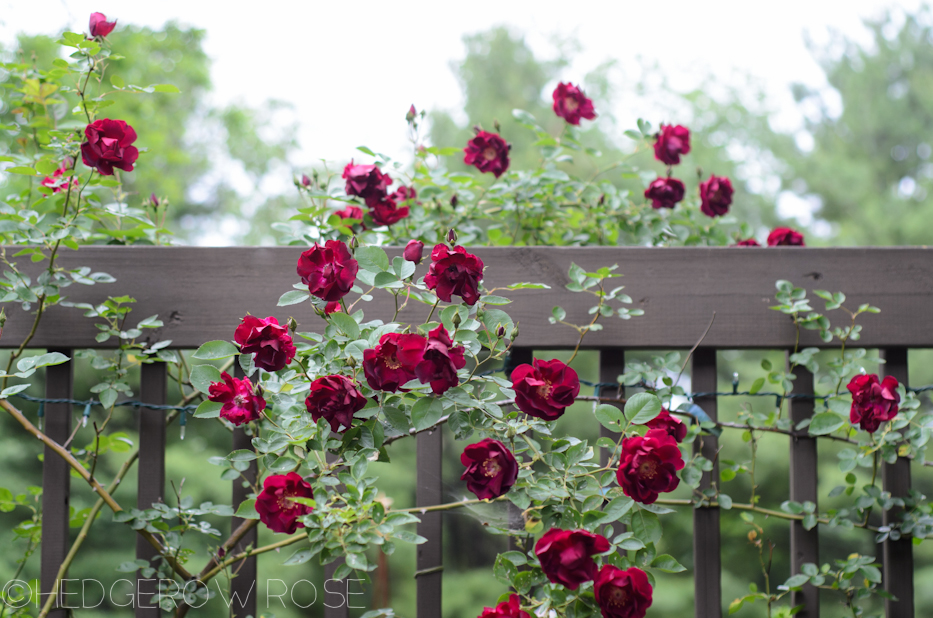
Dr Huey, introduced in 1914, is a dark red hybrid wichurana climbing rose now used primarily in the rose breeding business as a rootstock for budded roses.
The discovery and identification of this rose growing in our new garden solved a long-running mystery for me. I’d often wondered, as I drove through the older neighborhoods in our former stomping grounds, what that variety of dark red rose was that was growing in everyone’s front yard.
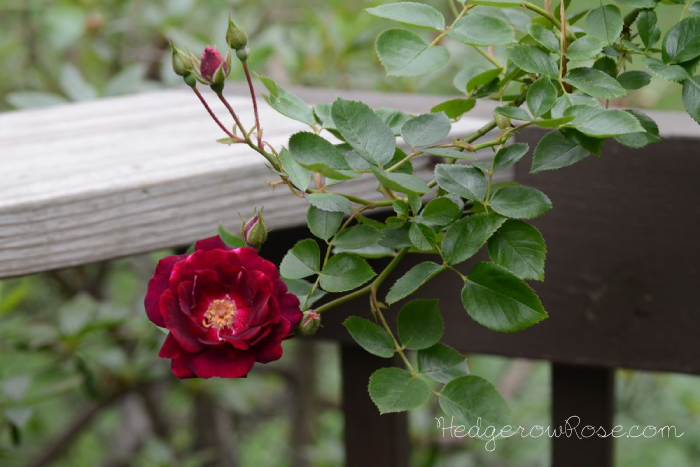
When we arrived at our new home in 2009, I noticed we had a sad looking little rose growing in an abandoned garden and recognized it immediately as the rose I had seen so often before. I guessed that it was the rootstock of a long-dead hybrid tea and as I nurtured it and watched it grow and flower beautifully, I dug in to do some research and discovered I was growing the Dr. Huey rose.

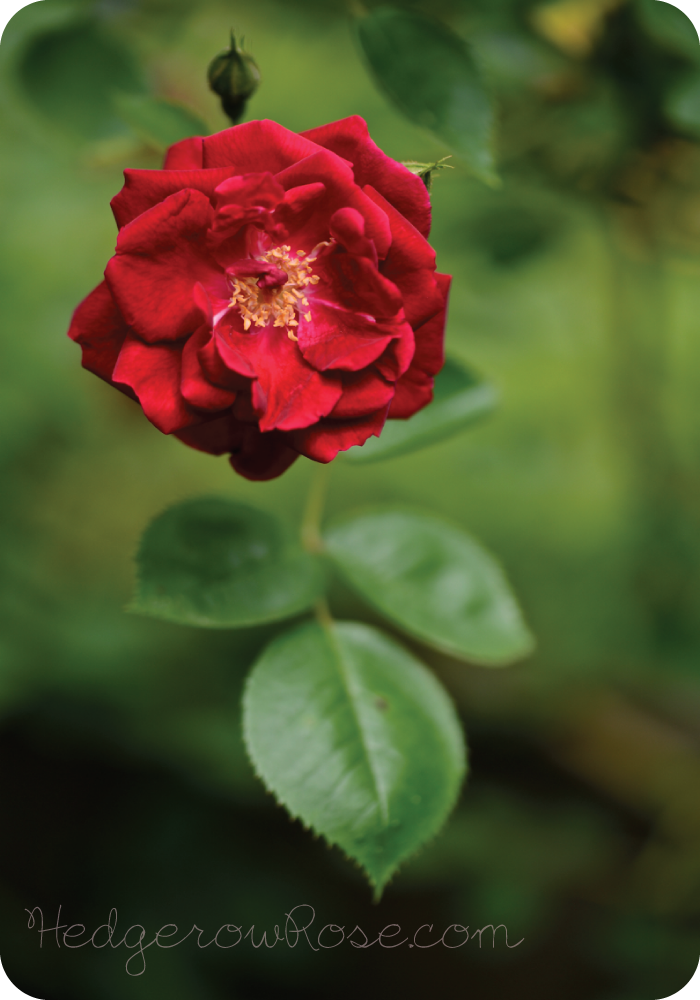
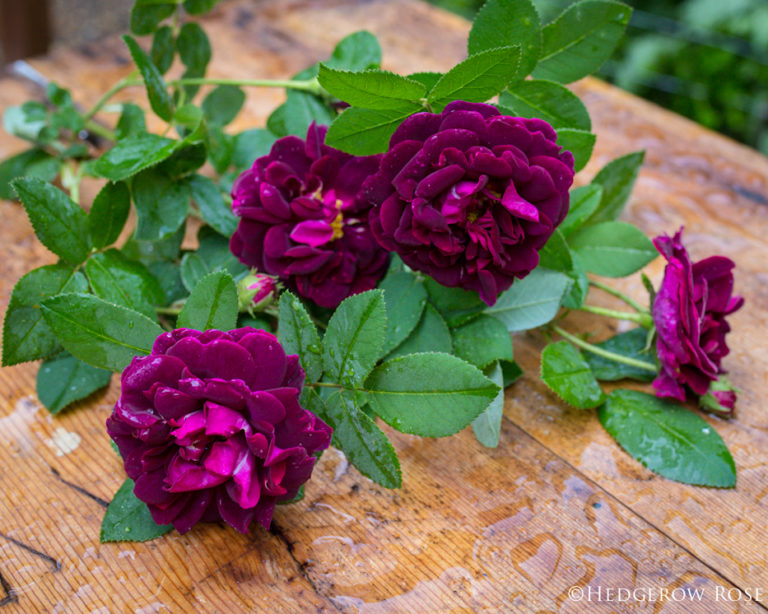
Dr. Huey (sometimes referred to as “Shafter”) was bred by Captain George C. Thomas in 1914 and introduced in 1920 by Bobbink and Atkins. It is quite possibly, inadvertently, the most widely grown rose in the United States, but more on that later. A Hybrid Wichurana (a rambler which can also be trained as a climber), Dr. Huey bears gorgeous clusters of deep red, semi-double blossoms with prominent yellow stamens in the late spring/early summer.

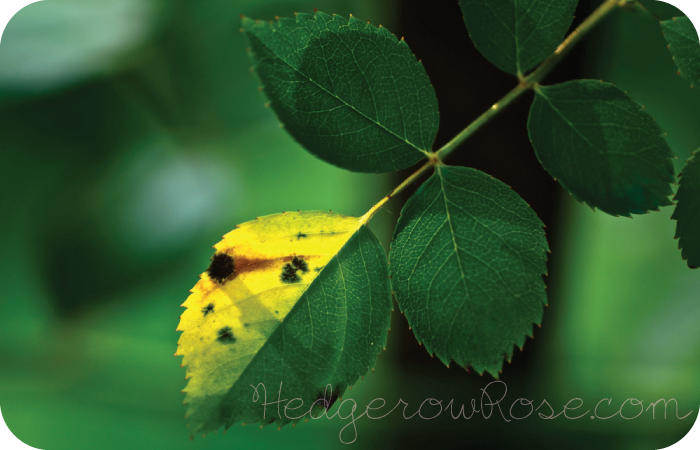
Dr. Huey is a gorgeous rose, but for me has one very annoying pitfall: it’s susceptibility to fungal disease. In our garden, after it blooms, every single leaf succumbs to black spot and eventually drops off despite my ministrations. Yet what Dr. Huey lacks in disease resistance, scent (I do not detect any), and lack of any repeat bloom, it makes up for in charm (when it’s blooming) and it’s sheer willingness to survive. In spite of it basically becoming completely defoliated by the end of summer and into autumn, it surprises me by returning the following spring grander than I expected.
It’s due to this incredible vigor that Dr. Huey is widely used as a rootstock for grafting bud eyes in the business of rose breeding and large-scale production. It offers ease of propagation and adaptability to various growing conditions and its negative traits (such as its susceptibility to mildew and black spot) do not pass on to the grafted rose.

Dr. Huey is used almost exclusively as a rootstock for grafting bud eyes in the business of rose breeding and large-scale production.
It’s quite possible that like me, you’ve already seen Dr. Huey growing rampant in older neighborhoods, abandoned gardens, and cemeteries. Or maybe you’ve wondered what that dark red rose is that suddenly appeared where your hybrid tea used to be. In colder zones, we’re taught to protect bud unions by planting it several inches below the soil line, and to remove suckers (canes that emerge from below the bud union). However, more often than not, the wrong rose is chosen for the wrong place, and diseased canes are removed (or they just die back) and the stronger, healthier canes emerging from the rootstock are left to consume the original rose. Over time, as the grafted rose dies, Dr. Huey flourishes, and that’s probably why it has become so prevalent.

Dr. Huey’s blossoms start out a deep, scarlet red, and then change to a dark magenta as they fade.
Dr. Huey blooms on year-old wood so if pruning is necessary, it should be done immediately after flowering. Ramblers such as Dr. Huey often produce quite a few basal breaks (new canes), so removing older ones will make for a healthier and more productive rose. Training the canes horizontally on a support will also increase the number of blooms. (Strips of old pantyhose are great for attaching canes to supports; a tip I learned from Martha Stewart.)
Dr. Huey is hardy to zones 5-9 and is tolerant of shade and poorer soil conditions.
On paper, Dr. Huey is not recommended to grow for it’s own sake. Even the American Rose Society scores it as “below average,” and yet somehow I couldn’t imagine this garden without it. Does that make sense? Of course not. But sometimes, you just can’t quantify a rose’s charms.
Fascinating! I have at least 5 of these red climbers that fit your description. I came to your site because I was looking for info about own-root roses vs. grafted. I had no idea these might be the roots of other varieties. Now I will probably dig all of them out, even though they are nice in spring.
Hi Caroline! Glad I could help! ‘Dr Huey’ is a very pretty rose, but I agree, he really only looks best in the spring. Carolyn Parker of “Rose Notes” writes a nice post about ‘Dr Huey’ which can be found HERE if you’re interested.
Do not panic when you have seen the unexpected guest emerge from the bottom below the bud union of your beautiful rose. There are three ways to deal with it.
1. If you treat it like unexpected sucker, just cut and remove it.
2. You can save it and let it grow stronger for future use as a rootstock cutting, I found the best time to make cutting in Las Vegas (Zone 8b~9a), Southern Nevada is September to October.
3. If the sucker comes form the bottom of a dead plant or weak plant. Then you can save and train it to your favorite size and graft it with your favorite variety.
4. For #2 & #3, make sure the Dr Huey sucker not showing any symptom of being virus infested. If so, just cut and discard, do not save for cutting or rootstock.use.
Great tips, Peter!
I believe i have a dr huey ! I have pics to send and a lot of questions if someone can help ! My email is rock777731@gmail.com thanks ! Joe
Hi Joe, I’d be happy to look at your photos. You can reach me via the contact tab at the top of your screen.
~Laurie
Thank you for identifying the Dr. Huey Rose i have found in my garden and at NJBG Perennial Garden. It popped up this year after much rain. Identifying old Roses is quite a challenge.
It definitely can be! There are so many and they often look alike. I’m glad you found what you needed. 🙂
I’ve been trying to figure out who Dr. Huey was named after and the history behind the man not the rose? I know the doctor well in our garden.
I’ve been working on a rose blog and today is Day 74. It is the 50th Anniversary of The Rose Cottage my Mother’s rose garden. She passed last October after a long hard journey with Alzheimer’s and it is in her honor. Over the last 50 years I have learned a great deal about roses that I am now sharing with photographs, illustrations, books, and the roses in the garden.
thanks you
judyaustin
Thank you so much! I bought a house and moved last June and when I was looking at the house, there was a rose with a few red/magenta blooms. I was excited – my very own rose at my very own house! But it never bloomed again. Someone recently suggested that it might be Dr. Huey and that the original rose died and the remaining root stock has continued to grow. After reading your post, I think that indeed I do have a Dr. Huey. They person who suggested it also recommended that I remove him, but I have grown somewhat fond of him and don’t think I can do that.
Hi Amber, I’m so glad this post was helpful to you!
I think Dr Huey is very beautiful when it blooms, so I agree with you, if you love it then why not keep it? Roses are meant to be enjoyed after all! 🙂
I ended up writing a blog post about him and linked to this post 🙂
http://www.amberwiseman.com/meet-dr-huey/
Yay!
Before moving to my new house, took cuttings from all the plants in the garden of my old house, including a gorgeous David Austin rose, of which I planted 9 in a row at the front of my house. This means that all of the roses were self rooted. It came as a surprise to me to find that somehow, I managed to get a root cutting from the original parent plant as I found the Dr growing happily among my David Austin roses. I dug the Dr out and planted it in a pot, my neighbour saw it, liked it and so I gave it to her after explaining that it was actually rootstock. Last summer I discovered a couple more Dr Hueys popping up next to roses I have purchased since moving here, they too have been removed and are now growing in pots.
What an interesting story and it sounds like you’ve got quite a collection, now! 🙂
I found Dr. Huey growing in my back garden just yesterday.
When we bought the house almost 30 years ago their was an heirloom rose bush in back, one of the first to ever be deliberately cultivated, almost like wild roses except for the color. And this year two stems of it bloomed dark red and fully double, unlike the others.
I kind of like the double bush, but I guess I’ll need to take a cutting from the older rose and grow it with its own roots if I want to protect it. I wonder why it took so long for Dr. Huey to show up.
After all these years–we owned the house since the 90’s, I finally understand why I have all these red roses! Last summer I bought autumn Sunset; this spring suddenly it was vigorous, and came out red.
Question: how do I know if the original graft is dead?
Hi Edwina! Sometimes you’ll see both Dr Huey and the rose you wanted sort of growing together, in which case you can still salvage the original by removing the suckering Dr Huey canes. If you haven’t seen the other rose in a while though, chances are pretty good it’s not coming back.
I have mixed emotions about Dr Huey. When I was first noticing roses in my mother’s yard some years ago, I was excited at ANY rose. And the flowers were pretty, passionately dark, and numerous when they came, seemingly without any effort on my or my mother’s part…so I enjoyed it for some years…until I really got into growing roses deliberately, which was about five years ago.
I realized it had grown out from an old Bob Hope rose my dad had planted, back in the early 1980s. Then, after he died, we had forgotten to do anything with that rose…really didn’t know anything about them…and this other one eventually showed up in place of the original.
So…after I became oh-so-sophisticated about this matter…once I knew it was a reliable vector for fungal diseases and only bloomed once in the year, and then the leaves would spot horribly and drop off, looking horrid for the rest of the growing season, I became annoyed by it and tried to eradicate it. I also would have liked the space it took up for something else—like another rose. Our flower beds aren’t that big, and we only have a few sweet spots around the house that get full sun; we have too many huge overshadowing evergreen trees my mother will not allow me to remove, even though they threaten the house. Oh yes. Well…
Dr Huey does not wish to be eradicated, as anyone who has had it knows. You chop it down repeatedly, it grows back—a week or so later, it has burst forth with renewed vigor, sending up its dark red shoots. As I understand it, you have to go after the roots, which I never had the arm strength to do; they are too well established. But as of this year, I thought we had finally gotten rid of it—in fall of 2014, my mother put in propane tanks back in the late fall to run her new gas generator, and these tanks were put in on top of Dr Huey. I thought, no more of this! No room for it. Well, yesterday, in late June 2016, I found some canes growing up out of the seeming nothing below. Dark red ones. The old fellow. Dr Huey again. I chopped it back, but without any confidence I would succeed in destroying it. I’ll keep chopping, doubtless, but basically, I’ve given up on the idea it will ever die—at this point, I don’t intend to grow any more roses near this plant, so if it grows, it grows.
My mother doesn’t mind it, in fact she thinks it deserves to grow if it is that insistent. But I’m totally over any great appreciation for Dr Huey…I can’t go back. It’s become a symbol of a gardener’s will being continually thwarted! A reminder almost as painful as the memory of all the rose bushes (at least twenty, after that great growing season of my first year, 2011) that I lost in 2012, 2013, 2014, to strange weather patterns, odd seasonal cycles, and deer munching in CT—through all this, Dr Huey prevails. (I finally gave up in 2013, 2014, and 2015 in putting in any new roses, except a couple in containers, which the deer ate. I just couldn’t take the disappointment of new failures. I tried everything to keep roses—but the weather was amok, stemming from the earthquake in Japan back in late 2011, which shifted the axis of our planet at least 2 degrees and messed up our seasons—too much wet at a time, too many bugs after the wet, too much heat suddenly and no rain, all in one summer—then cold spells in July—just constant awfulness that seemed designed to destroy anything but lilies and irises).
I can’t afford to put in raised beds, so I’m doing container roses now. Better than none!
Does anyone have ideas on how to encourage my rose plant, that’s probably a Dr. Huey, to bloom? I live in NH, zone 4. The plant has been extremely vigorous and the foliage healthy looking for 2 years, but no blooms. At another house 20 years ago and 20 miles from here, I had what certainly looked like current photos of Dr. H. It would be covered with beautiful dark red blooms for several weeks in June, but I think it only bloomed ever other year.
Philip, make sure your rose gets full sun (6+ hours daily). Most roses (Dr. Huey included, I would assume) need full sun to thrive and bloom. Another thing you could do is fertilize it in early spring right around the time it starts growing leaves. You should also prune some of the oldest canes—Google or look up on YouTube “how to prune rambling roses” and you should be able to find instructions–and carefully train newer ones horizontally. I hope that helps!
I am so happy to have found this site! Ive been trying to figure out what happened to my once beautiful Snowfire. It was always my childrens favorite, but that was 20 years ago. The homestead was vacant for quite some time, and as i pruned the old roses i had planted many years ago, i was puzzled by this rose that had taken the place of my Snowfire. Dr Huey is a beautiful addition, and i now have a new Snowfire to add back to the rose garden. Thank you for this information.
I recently discovered I have a Dr. Huey in my yard. It has been so since I moved into Sanctuary House over 20 years ago. What it was before that, I have no idea. All I know is it’s current growth and energy is very special. Mine repeat blooms, is drought tolerant, surviving the dry hot Mediterranean summer climate in San Jose, Ca, and has a wonderful scent…very rosey floral and spicey. I don’t do anything to care for it other than occasional pruning, talk to it several times a week, and simply enjoy it’s presence. I don’t even water it during the summer and it knows how to balance it’s own energy until the first autumn rains come. By not tending to this rose, Dr. Huey returned even deeper to it’s roots. An experience of holistic heart resonance, it’s plant heart divinely secured, supported deeply by it’s one true source, Creator. The effect being a return to thriving in harmony with Creator’s cycles in it’s surrounding environment versus struggling against those cycles.
I’ve worked with flower essences and vibrational remedies for over 10 years now and plants and their energy wisdom are such healers and teachers to us humans. Often when a plant is considered invasive or a pest, only it’s effect is being observed, but from a causal perspective, the invisible, much much more is going on. One of my gifts is tuning into that wisdom, learning from it and sharing it with others. The Plant Kingdom is very much of service to us, animals, and the earth trying to clear energy imbalances and disturbance in the magic mystical way of Creator.
Dr. Huey started speaking to me once I identified it. After discovering it was used for rootstock, I kept sensing, “return to your roots”. Dr. Huey’s healing rose wisdom is a return to holistic heart wholeness, a time when each human knew and understood a unity conscious cause, experience, and understanding of self in that way. That explains why I’ve always been drawn to it!!! It is hardy, and a survivor, carrying a thread of unity conscious wisdom that could not be eradicated from itself, even when used to support others (other roses as their root stock). It carries that wisdom in it’s rose heart for each of us. A thread of truth of the unity we are all in this together. A truth that cannot be eradicated from your heart no matter what is going on around you. It’s in every living thing as Creator blessed it to be from the very beginning. That awareness is returning and bubbling up in the hearts of many. I’ve ready many posts from gardner’s trying to eradicate this rose from their garden’s for it only to return and thrive. What an ally to discover I have had all along, right in my own front yard. I will be in plant kingdom classroom and holistic heart discovery with this rose that carries such ancient wisdom to gain more knowledge of it’s gifts.
You can visit my LinkedIn profile for photos of Dr. Huey in my latest post ☺️
https://www.linkedin.com/in/debimelzer/
Thank you Laurie so muuuuccch for this dr. Huey blog post! It was the delight of my day finding it!
Grace,
Deborah
You can also look at the #, appearance, and size of leaves as Dr’s leaves tend to be smaller, darker, in sets of 7, with thornes while typically hybrid’s leaves are larger, glossy-er, in sets of 5 … at least the ones I have seen.
Wonderful explanation! I really appreciated your fondness for this old rose, Thank you.
Thank you Judy! That’s so kind of you! 🙂
For the first time this year we had our roses professionally pruned. Ha! Our big Queen Elizabeth rose by the front porch had all its branches pruned away leaving several root stock suckers. We now have a sturdy , full of blooms, Dr. Huey, in its place. At first I was furious but now I am quite pleased– it is a beautiful rose.
Haha, your reaction is probably very common! 😉 And indeed it is a beautiful rose.
Beauifully written. Today I was doing yardwork and accidentally found my long-lost Dr. Huey growing next to a crabapple tree! Ten years ago I brought home a thornless pink-blooming rose cultivar from Home Depot. The cultivar succumbed over the winter and the following spring the rootstock took over. I relocated the rootstook way out into a partly cleared woodsy area of the property. For my kindness it returned next year with three gorgeous deep red flowers. The wild vegetation took over again and it disappeared among the green masses. Through the years I sometimes thought about the the humble, unassuming rootstock that gave up its beautiful blooms to me, or so I believe. It prompted me to research its identity. I learned it was Dr. Huey. Today is the first of June, a beautiful day. I am transplanting some monardas near a tree and my eyes suddenly took notice of a healthy plant nearby, bright green and one foot tall. It was a rose. It was Dr. Huey.
What a wonderful comment, Cy. I enjoyed reading about your Dr Huey rose. Thank you for this!
Thank you for identifying the Dr. Huey Rose i have found in my garden and at NJBG Perennial Garden. It popped up this year after much rain. Identifying old Roses is quite a challenge. We found another very old rose in a wooded area of an old farm. It is crimson red, small flower, many petals to count, scented with red on edge of leaves, and blooms heavily once in spring here in N.J. Tough to identify.
Hello and thank you for your write up! There is so much good information here:) I was chasing down the type of rose this Dr Huey was for months just by snapping pictures of it in neighborhoods or along the sidewalk in town because it is my absolute favorite rose!!! This is why it’s hilarious to me to now know that many rose enthusiasts are underwhelmed with it. Anyway, I purchased two baby plants on Etsy and planted them in a very sunny patch under my daughters window. They seem happy, as they both have a bit of new little leaves shooting off this year . My question is what can I use to fertilize them? I was told not to use anything the first year because any fertilizer could burn them? I have friends who use horse manure, but I wanted to touch base with you first:) thank you for your time:)
Hi Melissa, thank you so much for your kind words!
About fertilizer: “chemical” fertilizers like Miracle Grow do burn the roots of young roses so it is best to stay away from that stuff.
To be honest, I never use fertilizers, chemical or organic. I simply mulch thickly twice a year (spring and fall) with well rotted manure (roses LOVE composted horse manure) and kitchen compost. That will do the trick! Thanks again for your visit. 🙂
I had a Souvenir de la Malmaison rose that turned to a red rose. I’m assuming the graft died off, if that’s the way to describe it. Could it be the red rose left is this Dr. Huey rose? Interesting. I love roses but know so very little.
Hi Linda, that sounds like what happened. (Partly why I prefer “own-root” roses.) Antique Rose Emporium carries SDLM is you want another. 🙂
Thank you so very much!
My house was built in the ’50s, and I’ve been in it for nearly 30 years.The roses I have were there before me. Some may be Dr. Huey as they match the flower and blackspot descriptions you give. They usually bloom more than once, though. Not quite continuous, more like a second pass sometime later in the summer, after all the leaves have blackspotted and fallen off.. For some reason, they barely bloomed at all last year but had good foliage. This year, they’re blooming like mad and developing blackspot.
The other rose I have is also from rootstock by now. It’s a very pale, but not washed-out-looking pink. The flower shape is a little closer to tea rose (I think), but it’s more of a rambler type. Leaves are small and resistant to blackspot. It was happier before my neighbors put a shed on its east side, but it’s still trucking along. I’m mildly curious about what it is. Maybe Cecile Brunner?
Hi Judi thank you so much for your visit and sharing your experiences with us. Another rose used as a rootstock is Fortuniana. Click HERE for a bunch of photos and other info if you’re curious. 🙂
Such a nice post on how you rescued the Dr. Huey from an abandoned garden, so nice to hear someone say something positive about this little rose!
That’s so kind, Sue! 🙂
Hello! Thank you so much for sharing! We moved into our house about 7 years ago and have been wondering ever since what type of rose bush we have. Only recently have I truly tried researching, and I think it may be a Dr. Huey rose! I think it’s absolutely lovely! I just don’t know how to care for or prune it. And I think it may be currently suffering from a disease or some type of unwanted guest causing it’s leaves to drop from the bottom up! Any suggestions for someone that knows VERY little about roses (and pretty much gardening in general 🙃). Could I share a picture somehow to help identify the rose?! Thank you again for sharing your Dr. Huey knowledge!
Hi Emma, welcome! 🙂
If you wish to send me a photo, you can use the contact form above and I’ll be happy to help!
You can also click on this link which will take you to an info page with lots of additional photos of Dr Huey which may help you identify yours.
If I had to take a guess, I’d bet that your Dr Huey is showing signs of blackspot which is a fungal disease (very common in humid/wet areas in summer) and something Dr Huey is prone to. The best thing to do is to clean up any fallen leaves because they will harbor the spores and keep your rose mulched and given good air circulation. It may look unsightly but Dr Huey is a champ and mine always recovered and grew new canes in spite of the blackspot. As far as pruning goes, since Dr Huey is a “once-bloomer” it’s best to do any pruning just after flowering. (The growth from the previous year is what produces flowers the following spring.) Hope these tips help!
My Dr huey never has blackspot or mildew problems. It is planted next to leeks. It is one of my prettier roses. Grows in part sun and blooms like it is in full sun. Very thick and hardy. It’s definitely a rambler. Thanks for the info.
My 2 year old PINK Olivia Rose Austin roses suddenly sprouted red. I went looking for answers and discovered that most of the DA roses are grafted on the DH. WHAT A HORRIBLE PROBLEM! I don’t want a disease-prone rambler taking over my beautiful rose bed of English rose bushes and possibly infecting my other roses, and so it will not be transplanted elsewhere in my garden. Ripped that puppy right out by the roots! But I’ve noticed another rose growing up between the Olivia’s that has suspiciously dark red buds. It, too, will get ripped out. Also, will not put them onto the compost pile, just in case. Makes me angry that I paid that much for roses grafted onto such a horrible rose to eradicate.
Hi Anna, I share your frustration–I’ve been there!
For anyone reading this comment, David Austin *do* sell many of their roses as own-root (not grafted onto rootstock.) Here’s the link!
I have a dr huey and i cant imagine my garden without it either it has given me so much pleasure. It is beautiful.
Great article. We have been enjoying Dr. Huey for a month now………so much heartier than the climber it replaced. But we now know that we will need to fire the actor after the show.
I have a Blanc Double de Coubert that was sold to me as own root. However, when I found Dr. Huey growing from the ground and the grafted rose dying, I knew that Blanc Double de Coubert had been grafted. I had previously wondered why this Rugosa did not sucker like my other Rugosas. I cut the dead and dying grafted Rugosa canes off of Dr. Huey’s root stock, who is the rightful owner and has a right to grow from it’s own roots. Dr. Huey is beautiful with dark red petals and glowing centers, has a will to survive and deserves to grow and will stay in my garden. What is left of the grafted rose will be trimmed off, dipped into cloning powder, and started to grow on it’s own roots too.
Hi Janet, thank you for sharing your experience. I agree, it’s so much better having a rose on it’s own roots! 🙂
I became familiar with Dr. Huey while living in Oregon. One of my own roses failed except it didn’t. Being the champion of underdogs I took care of it and let it prosper. Then I started seeing it everywhere just like you. Now I’ve moved to a different state, and the seller asked me to keep this rose intact because her grandmother planted it. It’s not the rose planted, it’s Dr. Huey! I’ll probably keep it because I know for sure it will live on forever.
Wow that’s a great story, Jennifer! Thank you so much for being here and sharing your experience with Dr Huey. 🙂